Friday, August 23, 2013

A Tale of Two—No, Three—Libraries


Last Tuesday I found myself in New York City, with a few hours in the afternoon to spend. I’d arranged to meet my Vergil, Jon Bruner, at the New York Public Library. Awaiting Jon on the steps, I felt I’d stepped into a W.H. Whyte map: 

The place demands interaction, and lo! a fellow sitting behind a tray table, with a sign on on the front proclaiming, “MEET THE AUTHOR.” Well, why not? The gent turned out to be Garrett Buhl Robinson, and he read from his books, with a pitch-perfect southern accent and pace. As an editor, I caught some quibblable phrases, but on the whole, the imagery, the connection of the personal and the historical and, the rhyme between structure and sentence were impressive.

The Library is, of course, an astounding achievement, not just a monument to the democratization of knowledge, but an ongoing project of the same. The openness of the reading rooms and the easy access to the collections are obvious. And my god, is it astoundingly beautiful.
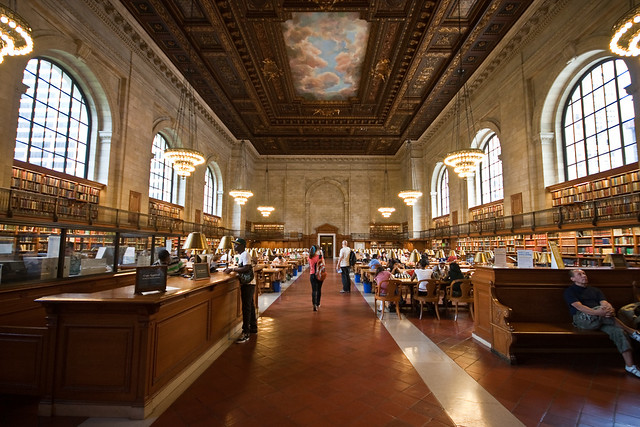
New York Public Library

But wait, as they say; there’s more! The NYPL does its exhibits well, too (we went to The ABC of It: Why Children’s Books Matter), as any good late-20th-century research library does. The building renovation, subject of debate is one indicator of their thinking about the future—I’ve got no dog in that fight but it’s easy to see that they’re focused on their users and trying to continue providing what their users need.

But let me back up a week and mention the last time I came across the NYPL. A few years ago, it would have been in the course of acquiring images from their collection; this time it was much more exciting.* The NYPL map vectorizer is a really cool tool to extract data from paper maps and encode it as geographical information that can be layered with hundreds of other layers and kinds of information.

What’s more, it’s a totally open-source project on GitHub, so you can tweak it to your purposes or contribute to improving the original project. This is democratization of research at its highest. Given the range of what NYPL has put on GitHub, they are taking ‘public’ very seriously.

Changing gears

The next stop after the NYPL was the (Morgan Library and Museum)[http://www.themorgan.org/home.asp]. An utterly flabbergasting place, it was J.P. Morgan’s personal study and library, since converted into a research library and museum, with an appendix by Renzo Piano. The presence of so many historically mindblowing and phenomenally valuable things (three Gutenberg Bibles! manuscripts from Percy Bysse Shelley to Blowin’ in the Wind! I could go on, but I’d break down in tears) in such a setting was almost too much.

(As an aside: if you go, be sure to ask the security guards—they are very well-informed—about the staircase. I won’t spoil the surprise.)_C020271.jpg 
It’s good to be the richest man in America (and to have Belle da Costa Greene managing your collection and acquisitions).

Between the NYPL and the Morgan, we have two wonderful and very different libraries, mappable onto (let’s be honest—ancient Athenian) notions of democracy and oligarchy. But they called to mind a third library, George Washington’s library at Mount Vernon.

Washington was, according to the Atlantic, America’s wealthiest president. Yet his library had a mere 1,300 volumes (1,287 + maps, charts, etc, to be specific). Mine has about 700 (probably a few more; I haven’t updated my catalogue in a systematic way in a while). Mount Vernon is about 7,000 square feet; my house is about 3,200. You see where I’m going with this: One of the wealthiest men in America, and our first president, had a standard of living (hey, can you think of a better measure than library and living space?) broadly comparable with mine; the multiplication and spread of wealth and knowledge brought about by the Industrial Revolution is embodied in these three buildings.

*Your excitement level may vary.

Tuesday, July 23, 2013

Some thoughts on the AHA's statement on Open Access


This is just a brief note on the AHA Statement on Open Access (with a special hat-tip to Jason M. Kelly’s insightful point-by-point response).
Though I’m writing from a standpoint within academic publishing, I won’t comment on whether we deprecate works published open-access as dissertations (for various reasons I'm sure you can imagine). I want to pull the focus back a bit and point out a few obvious things. (Hey, somebody has to!) The AHA’s statement is quite pragmatic in working within the status quo: publishers have a lot of power, especially over young academics’ careers.

However, publishers have that power because departments (and, perhaps more crucially, university administrations above them) have given it to them: hiring and tenure are not, cannot be done in today’s university, on the basis of a departmental decision. Rather, there needs to be outside evidence, measurable evidence!—checklists and scores and quantifiably lawyer-proof mountains of Why we hired X and not Y. This is a fact of life, and the AHA is wise not to take on the ABA (and that ain’t the booksellers’ association here).

But the AHA could have done more. Let me quote one point from the AHA and Kelly’s counterpoint.

AHA: By endorsing a policy that allows embargos, the AHA seeks to balance two central though at times competing ideals in our profession–on the one hand, the full and timely dissemination of new historical knowledge; and, on the other, the unfettered ability of young historians to revise their dissertations and obtain a publishing contract from a press.

Kelly: It is important to protect the interests of early career historians.  But, this statement seems to understand their interests narrowly.  What kind of academic community should we help craft with them?  I would suggest that we help craft a community of openness and collaboration — one that embraces technologies that are likely to expand our impact and reach wider audiences.  This may mean remaking the conventions of the profession and likely requires that we abandon ad hoc attempts to protect the status quo.  This will likely mean confronting the habitus of our profession and disrupting the institutions that we have been working in for over 100 years.
(my emphasis)

The “ability of young historians to revise their dissertations and obtain a publishing contract from a press” is not by any possible stretch of the imagination an “ideal in our profession”—it’s a means, a practical stepping point to keep future scholars in business. But far more importantly, academic publishing is exactly the business of “full and timely dissemination of new historical knowledge.”

And here’s where the AHA erred. They should have called out both publishers and their own membership for slowing down the timely publication of new scholarship. “Confronting the habitus of our profession and disrupting the institutions” is another way of saying, “We need to raise our game to a new level, and fast, or we're going to be looking for a new game."

Young scholars--don't just "obtain a publishing contract," make that diss into a manuscript. 
Senior scholars--turn around your goddamn manuscript reports.
Publishers--you know how complicated this is and the gazillion things that can derail or slow publication.

Everyone: Do it better. 


Sunday, April 14, 2013

Twelve movies about food

To watch over the coming months. I haven't seen all of them, additions or recommendations welcome.

  • Big Night
  • Jiro Dreams of Sushi
  • Scent of Green Papaya
  • Like Water for Chocolate
  • Babette's Feast
  • Moonstruck
  • Tampopo
  • Mostly Martha
  • Julie and Julia
  • Delicatessen
  • Ratatouille
  • The Cook, the Thief, His Wife, and Her Lover

Wednesday, April 3, 2013

Accidental Haiku

The New York Times has gone and created a haiku-generator—no, it's a haiku-discoverer, pulling haiku-meter quotes from NYT articles. It's based ultimately on an open-source Python program, written by Jonathan Feinberg. I grabbed the code and tackled my sent email from the past few months. Here are the (better among the) results:


I may ask for house
    keys later but we'll see how
the day is going.

The other issue
    is one of length -- and this could
be a bit tricky.

Save your work often,
    you know how reliable
your computer is.

I think m4m
    is a little too oblique
for a subtitle.

Hope you celebrate
    with champagne and foie gras, or
some facsimile.

And, as expected,
    the Terman and Kinsey books
are totally cool.

I should start to look
    at those if I'm sending it all
in less than two weeks.

They are not stylists,
    but their writing is clearly
comprehensible.

Do you want to hang
    out with daddy more because
he is not as brown? 

Then they went and moved
    the whole thing to Las Vegas,
ruining our plan.

Just took a skim-look.
    I think this is a good plan.
But not a good goal.

This is, however,
    putting some parts of the cart
before the horses.

She has published two
    dozen journal articles
in addition. Bored?

Yup, that's it! The back-door
    one has been clicking away
since February.

Or is discretion
    dictating another day
in prone position?

Is there anything
    additional coming, or should
I just remove that?

Ponder what you might
    do with a few extra hands
for a long work day.

It is hard to lift
    out the title embedded
in the lighter text.

As a grad student,
    you're managing one big project,
the dissertation.

So I got involved
    in the 'keeping the author
happy' end of things.

You can tell her, too,
    that we're processing the second
half of her advance.

Monday, February 18, 2013

On selling a bike


I sold a bike this weekend. I’d had it for a bit over a year, and had a ton of fun riding it, but I hadn’t ridden it in four months, and when a friend posted a “Want to Buy” for just such a beast (single speed mountain bike) on the local bike forum, it was a clear sign that it was time to pass it on to another rider.

Selling a bike is always an occasion for mixed feelings, but three main currents stand out. First, there’s the thrill of freeing oneself of a possession, particularly a possession that has become part of one’s identity. Second, there’s the regret at the loss of a freedom; there are now paths I can’t ride which I probably could have. Third, there’s bewilderment: “How does the money disappear so fast?” 

Tuesday, February 12, 2013

Map Is Not Territory*

It's not enough to write a book any more. Now you have to write a proposal to get the book under contract, a grant application to get funding, another grant application to get funding (rinse and repeat as necessary), a report for your department on what you've done this year, and what you plan to do next year... and now your publisher is asking for chapter abstracts and keywords when you send the final manuscript in for editing.

"Have you had any push-back from authors?" our manager asked. Well, no. They're used to writing about what they've written about—not that it's necessarily enjoyable, or valued. But the reflexivity of that activity (writing about what you're writing about) isn't just a cute way of stating the obvious, it reveals a bit of a truth about writing: the object of the writing (the research, the story) and the writing itself aren't easily separable. You're always trying to tell the story, you're always inevitably condensing and narrating and leaving out and framing and filtering. Whether you're giving your elevator pitch ("You'll love it; it's about this early modern German named Hermann Connring and the fundamental shift in the relationship of past and present.") or writing an 800-page manuscript, or editing that manuscript down to a reasonable 120,000 words, or even distilling that manuscript into a 7-line table of contents (Germans, by the way, call it a "table of content"—that little change always reminds me that there must be substance to the book.), it's always a representation. The only sharp line in representation is between the representations and reality.

And so, no, we don't get push-back. Maybe grumbling about another task to do, but hey, we've been adding to authors' tasks to do ever since we took away their typists (well, most of their typists) thirty years ago. (The division of labor giveth, and the division of labor taketh away.) We still overexplain the need; we throw around words like "mixed media environment," "searchability," and "discoverability," but fundamentally, we're asking for a map.

And so I write: You’ve already created one map of your book: the table of contents. The table of contents is a large-scale “highway map” of the general route that your readers will take. There will soon be another map in the form of an index; this is a very local map (“Where was that excellent taco restaurant? Come to think of it, where are all the taco restaurants? This guy did a wildebeest-shooting helicopter ride but I want to do a cross-country taco hop.”). The abstracts and keywords are yet a third kind of map: they’re like the maps posted on signs at the entrance to a campus, with a “you are here” to situate the visitor, and to show that reader, who may not have come in the main entrance, what there is to see. Publishing now involves searching and coming at books (and chunks—that's a technical term—of books) from all sorts of directions, and so you can't rely (if you ever could) on a reader looking at the Table of Contents and the Introduction.

But it's all representation, and it's What Authors Do.

*Thanks to J.Z. Smith for my title phrase.

Thursday, September 13, 2012

Naked teaching

We interrupt our regularly-neglected programming to bring you thoughts on "what I’ve learned from our week of small-group schooling (in brief)." (Future generations and foreigners reading this may want to know that this is occasioned by the Chicago Teachers' Strike of 2012.) When you have a classroom full of kids, it’s fairly easy to get them all to do the same thing. You put on an air of command, say “sit down,” they all sit down. You say “listen,” and you can even get them (yeah, it may take some barking and nipping at the heels of the wanderers) all to sit quietly and look up at whatever you’re showing them. When you’ve only got two or three, they’re a lot harder to control. They each want to talk more—no, they all want to talk, all the time. Except for the one(s) who never want to talk (but with them, you can’t say to yourself, well, he’s quiet and not disturbing the class; he must be doing ok). You have to get them all to buy in to what you’re doing, because there’s no pressure to conform working in your favor. You have to work harder. You can tell when they’re not learning, when their attention is wandering, when you just haven’t got the right tone or metaphor or explanation. You work harder, you re-pitch what you’re saying, you have to reach each of them individually. You have to work harder. They learn more. They work harder (Evidence: Nellie has been completely exhausted every night this week.). There’s no hiding in a class of three: they can’t hide behind a superficial conformity; you can’t hide behind public persona, and, more importantly, the group pressure to conform that can make it look like they’re all learning. Differences between kids stand out. The ones who get whatever you’re talking about get it, and want to move on. They can’t—they realize they don’t have to—slack through something they can do quickly. The ones who don’t get it on the first go-round—you can’t move on until they’re ready, because you can see it in every part of their bodies when they haven’t got it yet. You have to figure out how to resolve this. It’s exhausting and great. It’s not scalable (though the really great classroom teachers come close).